


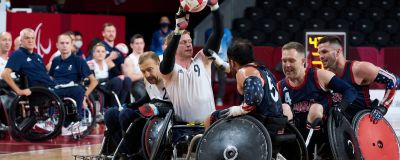

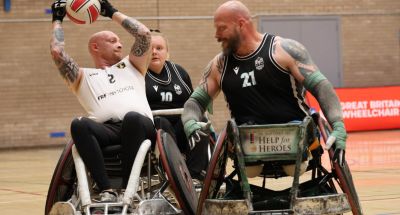
Photo: Para Sport Festival 2024: Wheelchair Rugby Welsh Open
To find out how to start participating in Judo you can refer to the DSW club finder or visit the
Welsh Karate Website.
National Governing Body for Karate in Wales:

For more information about coaching and volunteering, please Contact Us.
Mae yna lwybrau sy’n arwain at:
 Pencampwriaethau'r Byd
 Gemau Virtus
I ddarganfod beth yw eich potensial ac i gael arweiniad ar lwybrau cystadleuol, llenwch ffurflen #ysbrydoli Chwaraeon Anabledd Cymru.
Eligible Impairments: visual impairment.
Para judo is for athletes with vision impairment, though unlike many of the other sports for athletes with vision impairment, it has its own sport-specific classification system. For judo, vision is assessed in a binocular fashion, meaning both eyes together. Athletes are also grouped into different weight categories within their Sport Class.
Sport Class structure:
J1: for athletes with no to very low visual acuity (LogMAR greater than 2.6).
J2: for athletes with visual acuity between LogMAR 1.3-2.5, or visual field of 60 degrees or less in diameter.
You can find out more about the eligible impairment types in Para Judo here
Mae Chwaraeon Anabledd Cymru yn gallu dylanwadu, cynnwys ac ysbrydoli mewn chwaraeon gyda chefnogaeth ein partneriaid.

SPAR UK (AF Blakemore Ltd.)



Cydnabyddiaeth swyddogol y Comisiynydd yw’r Cynnig Cymraeg a chaiff ei rhoi i sefydliadau sydd wedi cydweithio â swyddogion y Comisiynydd i gynllunio darpariaeth Gymraeg uchelgeisiol. Mae’n cefnogi cynllun tymor hir y Comisiynydd i sicrhau y gall pobl ddefnyddio’r iaith Gymraeg ymhob agwedd o’u bywydau, ac ar draws Cymru. Derbyniodd gydnabyddiaeth y Comisiynydd ar 3ydd Mehefin 2024. Ein Cynnig Cymraeg.





Dewiswch eich opsiwn gorau:
Dewiswch eich opsiwn gorau:
Mae'r modd lliw Golau wedi'i ddylunio gan ddefnyddio lliwiau brand Chwaraeon Anabledd Cymru, i gwrdd â Lefel AA Canllaw Hygyrchedd Cynnwys Gwe. Dylai hyn ddarparu cyferbyniad da i'r rhan fwyaf o ddefnyddwyr.
Mae'r modd lliw Tywyll hefyd yn defnyddio lliwiau brand Chwaraeon Anabledd Cymru, ond yn gwrthdroi golau a thywyllwch i greu fersiwn "modd nos". Fe'i bwriedir ar gyfer pobl nad ydynt yn hoffi sgriniau llachar, neu sy'n dymuno defnyddio eu harddangosfa mewn ffordd fwy ynni-effeithlon. Nid yw'r opsiwn hwn yn bodloni Lefel AA Canllaw Hygyrchedd Cynnwys Gwe, felly efallai na fydd yn addas ar gyfer defnyddwyr â nam ar eu golwg.
Mae'r modd lliw Tawel yn defnyddio lliwiau a allai fod yn fwy addas ar gyfer defnyddwyr sy'n sensitif i liwiau llachar, neu sy'n ffafrio cyferbyniad is. Nid yw'r opsiwn hwn yn bodloni Lefel AA Canllaw Hygyrchedd Cynnwys Gwe, felly efallai na fydd yn addas ar gyfer defnyddwyr â nam ar eu golwg.
Mae’r opsiwn Cyferbynnedd Uchel wedi’i deilwra i gyrraedd Lefel AAA Canllawiau Hygyrchedd Cynnwys Gwe, a’i fwriad yw gwneud y wefan hon mor hygyrch â phosibl i ddefnyddwyr sydd â’r craffter gweledol isaf. Byddai defnydd delfrydol o'r gosodiad hwn yn cael ei gyfuno â maint testun Testun Canolig neu Testun Mawr.
Mae ein steil botwm rhagosodedig yn defnyddio cefndiroedd lliw bloc sy'n cyferbynnu â chefndir y dudalen.
Gallwch newid hwn yn ddewisol i ddefnyddio botymau sy'n cynnal yr un lliw cefndir a lliw testun â phrif gynnwys y wefan, ac sy'n dynodi mai botwm gydag amlinelliad yw hwnnw. Gall hyn fod yn well gan ddefnyddwyr sy'n gallu darllen golau-ar-tywyll neu dywyll-ar-golau gyda mwy o gysur.
Dewiswch eich opsiwn gorau:
Gallwch ddewis lleihau'r defnydd o briflythrennau ar gyfer penawdau ac is-benawdau os ydych chi'n ei chael hi'n haws eu darllen mewn Achos Frawddeg. Gellir rhywfaint o destun, gan gynnwys acronymau, dangos mewn priflythrennau o hyd.
Dewiswch eich opsiwn gorau:
Mae'r wefan hon weithiau'n defnyddio animeiddio i ddod â'r cynnwys i fyw. Os hoffech chi analluogi hyn, gallwch chi wneud.
Dewiswch eich opsiwn gorau: